Kellyjev kriterij i rulet
Kellyjev kriterij govori igraču koji ima prednost koliko uložiti. Za rulet daje jasan odgovor: ništa.

Kellyjev ulog = prednost / izgledi. S negativnom prednošću formula vraća negativan udio, što znači: ne kladite se. Kriterij je ipak koristan da se shvati zašto su igrači na pristrane kotače određivali uloge kako su ih određivali i zašto bi svi ostali ulog trebali određivati prema budžetu.
Kriterij
John Kelly (1956) asked how a gambler with a known edge should size bets to maximize long-run growth of the bankrollnovacBankrollUkupan iznos odvojen za igru. Upravljanje bankrollom znači odlučiti koliko ćete od njega riskirati po okladi i po sesiji.Pročitajte cijelo →. The answer, for a bet paying b to 1 with win probabilitymatematikaVjerojatnostIzgledi da se neki ishod dogodi, od 0 do 1 ili od 0% do 100%. Jedan broj: 1/37 = 2,70%.Pročitajte cijelo → p and loss probability q = 1 − p, is to stake the fraction f* = (bp − q) / b of the bankroll. Positive f* means bet that fraction; zero or negative means do not bet. Kelly worked at Bell Labs, and his paper, “A new interpretation of information rate”, set the problem in Claude Shannon’s theory of information: a gambler who gets tips over a noisy line, at fair odds, can grow the bankroll at best at the rate the line carries information. This is a growth objective under a probability model, not a promise to finish ahead after a particular number of bets. A spending limit, finite deadline or payoutnovacIsplataOno što dobitna oklada donosi, izraženo kao „X prema 1” povrh vraćenog uloga.Pročitajte cijelo → cap changes the decision problem.
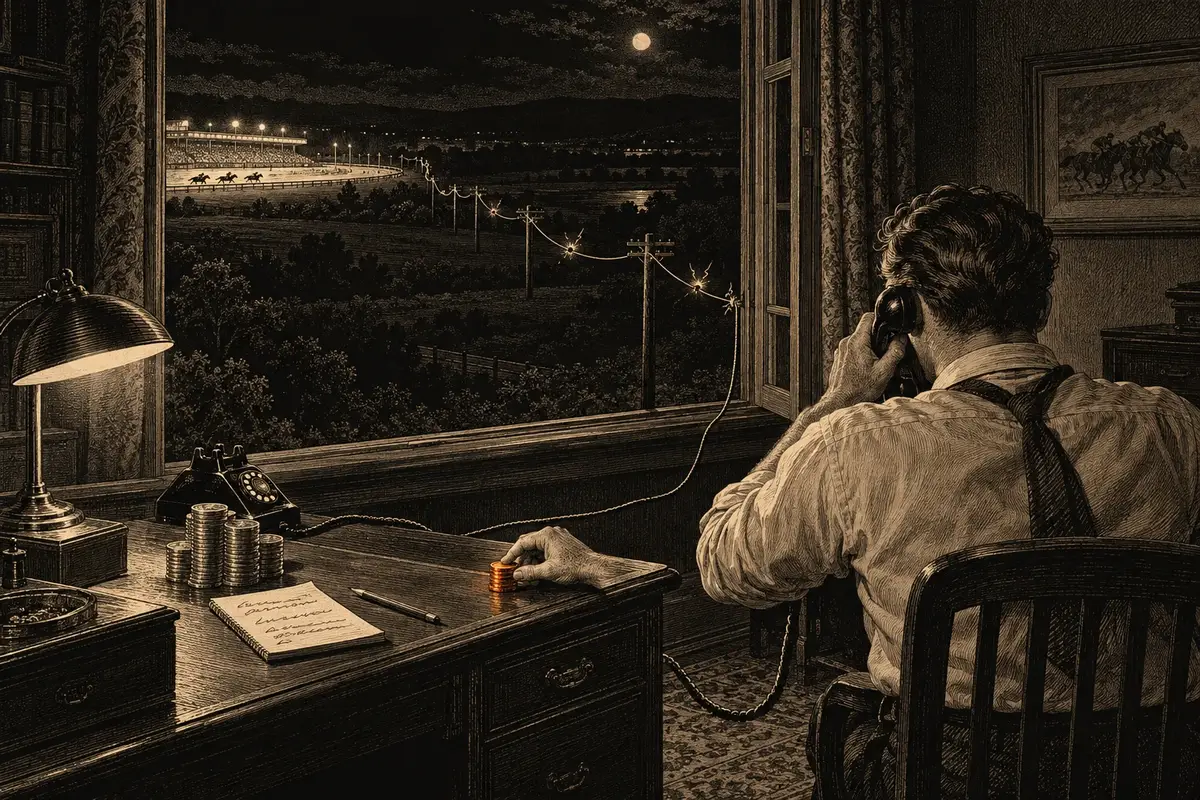
Kellyjevo klađenje u ruletu
For redokladaCrvenoOklada na jednostavnu šansu na 18 crvenih brojeva. Francuski: rouge.Pročitajte cijelo →: b = 1, p = 18/37, q = 19/37; f* = (18/37 − 19/37)/1 = −1/37. For a straight upokladaJedan broj (straight up)Jedan jedini broj, isplaćuje 35:1.Pročitajte cijelo →: b = 35, p = 1/37, q = 36/37; f* = (35/37 − 36/37)/35 = −1/1295. Every standard bet gives a negative Kelly fraction, because every bet has a negative edge, and the growth-optimal stake is zero. Kelly betting on roulette is a formal way of saying what the house-edge page says: no positive stake maximizes expected logarithmic growth when the bet has negative expectation. A particular session can still end in profit. La partagepraviloLa partageFrancusko pravilo: kad padne nula, vraća se polovica uloga na jednostavnu šansu. Prepolovljuje prednost kuće na tim okladama na 1,35%.Pročitajte cijelo → needs a separate three-outcome calculation: a win, a full loss or a half-loss on zerokotačNulaJedini zeleni pretinac, koji ne pokriva nijedna oklada na jednostavnu šansu, tucet ili stupac; izvor prednosti kuće. Također: jedna nula, 0.Pročitajte cijelo →. Its expected log growth also falls as the stake increases from zero.
| oklada | b | p | f* = (bp − q)/b | značenje |
|---|---|---|---|---|
| crveno, europski | 1 | 18/37 | −0,027 | ne kladite se |
| crveno, la partage | tri ishoda | 18/37 dobitak; 1/37 gubitak pola uloga | binarna formula ne vrijedi | 0% ulog optimalan za rast |
| jedan broj | 35 | 1/37 | −0,00077 | ne kladite se |
| jedan broj na pretincu 1/30 (pristran) | 35 | 1/30 | +0,0057 | uložite 0,57% bankrolla |
| jedan broj na pretincu 1/25 | 35 | 1/25 | +0,0126 | uložite 1,26% bankrolla |
Gdje se Kelly doista primjenjivao
Suppose a pocketopremaPretinacJedan od 37 numeriranih odjeljaka na rotoru. Također: slot, cup.Pročitajte cijelo → really has a stable, known probability of 1 in 30 and pays 35 to 1. The Kelly fraction is 0.57%: about $57 from a $10,000 bankroll. Under independent spinsmatematikaNezavisni okretajiSvaki okretaj ima iste vjerojatnosti bez obzira na povijest. Temelj svakog izračuna na ovoj stranici.Pročitajte cijelo → and exact fractional staking, the geometric growth factor over 1,000 spins is about 1.7. Expected bankroll grows faster because rare large wins pull up the average. These are model calculations, not evidence that any named historical player used Kelly or achieved this result.
Tipično i prosječno
The gap between the typical bankroll and the average one is wide. Take a pocket that hits 1 time in 25, a hypothetical edge of 44% per unitnovacJedinicaOsnovni ulog u kojem računa sustav ili igrač. Progresije se opisuju u jedinicama kako bi vrijedile za bilo kojim stolom.Pročitajte cijelo → staked. Kelly stakes 1.26% of the bankroll on it. After 1,000 spins the typical bankroll has grown about 11.5 times, while the average, pulled up by a few very lucky runs, has grown about 249 times. Betting more than Kelly raises the average and lowers the typical result: at twice the Kelly stake the typical bankroll only doubles, and by two and a half times the Kelly stake it shrinks, although every bet still carries a 44% edge. In this example, half-Kelly retains about 78% of the expected log growth. This fraction depends on the probabilities and payout.
| ulog, udio Kellyja | ulog, % bankrolla | tipični bankroll nakon 1.000 okretaja |
|---|---|---|
| ½ | 0,63% | × 6,7 |
| 1 | 1,26% | × 11,5 |
| 1½ | 1,89% | × 7,4 |
| 2 | 2,51% | × 2,2 |
| 2½ | 3,14% | × 0,38 |
| 3 | 3,77% | × 0,04 |
Kad je prednost nagađanje
Kelly uses the true probabilities, but a player usually has only estimates. Selecting the busiest pocket from a past record creates a selection problem: even a fair wheel has a busiest pocket. Its observed rate can overstate its future probability. Choosing the stake from that same record compounds the error. An independent follow-up sample helps test a proposed bias (see How to Detect Roulette Wheel Bias). Reducing the calculated fraction reduces exposure, but cannot turn a false edge into a real one.
Ljudi s prednošću
Haghani and Dewey (2016) studied 61 participants given $25 and 30 minutes to bet on a simulated coin with a disclosed 60% chance of heads. The payout cap was $250; its value was revealed when a proposed winning bet would reach it. Their reported 21% success category included balances of at least $200, while the 28% “bust” category meant less than $2, not necessarily zero. Eighteen participants bet their entire balance on one flip. The uncapped Kelly fraction is 20%, but the cap and deadline change the optimization problem. The experiment illustrates how stake choices matter even with a known advantage; it does not establish one best strategy for every objective.
Što koristiti umjesto toga
Bez prednosti veličina uloga pitanje je budžeta, a ne rasta: ulog = ono što ste spremni potrošiti po okretaju, izvedeno iz budžeta po satu i tempa stola (stranica Upravljanje bankrollom). Kellyjev doprinos običnom igraču jasnoća je njegova odgovora: nula. Sve što uložite iznad nule cijena je igre, koju birate vi, a ne optimizira je nikakva formula.
Napomena o djelomičnom Kellyju i „upravljanju novcem”
Betting a fixed percentage of the current bankroll is proportional staking: the stake rises after wins and falls after losses. Flat bettingstrategijaKlađenje stalnim ulogomUlaganje istog iznosa u svakom okretaju. Polazište s kojim se uspoređuje svaka progresija.Pročitajte cijelo → instead keeps the cash stake fixed. Neither creates an edge on ordinary roulette. With infinitely divisible stakes and a fraction below 100%, proportional staking never reaches exactly zero in finitely many losses, but the balance can become arbitrarily small. Real table minimums can prevent further play much sooner. The growth-optimal fraction remains zero.
Formula
Pitanja
Only when the actual probabilities, payouts and conditions give a credible positive advantage. Standard bets on an unbiased wheel have no such advantage.
Using half the calculated fraction reduces exposure to errors in the estimated edge. The familiar three-quarters-growth rule is an approximation for small advantages, not a universal identity. It does not protect against an edge that does not exist.
Ne. Kelly optimizira rast kad prednost postoji. Upravljanje bankrollom nadzire potrošnju kad je nema.
Zabavna matematika
Najprije ih pokušajte riješiti sami. Svako je rješenje skriveno; otvorite ga kad budete spremni.
Suppose a hypothetical bet on one number has a known 44% edge under standard payoutsnovacIsplataOno što dobitna oklada donosi, izraženo kao „X prema 1” povrh vraćenog uloga.Pročitajte cijelo → and independent spinsmatematikaNezavisni okretajiSvaki okretaj ima iste vjerojatnosti bez obzira na povijest. Temelj svakog izračuna na ovoj stranici.Pročitajte cijelo →. Kelly gives a 1.26% bankrollnovacBankrollUkupan iznos odvojen za igru. Upravljanje bankrollom znači odlučiti koliko ćete od njega riskirati po okladi i po sesiji.Pročitajte cijelo → fraction. What if the same 44% edge came on one bet spread over five neighboring numbers?
Prikaži rješenje
Odgovor Kellyjev kriterij tada kaže 7,1% bankrolla, a bankroll raste gotovo šest puta brže: oko 1,25 milijuna puta u 1.000 oklada, prema oko 11,5 puta.
A straight upokladaJedan broj (straight up)Jedan jedini broj, isplaćuje 35:1.Pročitajte cijelo → with a 44% edge wins with chance 0.04, since 36 × 0.04 = 1.44. Kelly’s stake is the edge divided by the odds: 0.44/35 = 1.26%. The typical growth per bet is 0.04 × ln(1 + 35 × 0.0126) + 0.96 × ln(1 − 0.0126) ≈ 0.00244, so 1,000 bets multiply the bankroll by about e^2.44 ≈ 11.5.
Spread one stake over five numbers and the bet wins with chance 0.20 and pays 36/5 for 1, that is 6.2 to 1: still a 44% edge, since 0.2 × 7.2 = 1.44. Kelly’s stake becomes 0.44/6.2 = 7.10%, and the growth per bet 0.01404, about 5.75 times as much. Over 1,000 bets that is e^14.04, about 1.25 million.
The edge is the same; the swings are smaller. A bet that wins one time in five has a larger growth-optimal fraction in this model, although losses can still reduce the bankroll severely. This comparison assumes the same known edge for both bets; actual predictions need independent evidence.
Assume two numbers are adjacent on the betting layoutopremaPloha za klađenjeOtisnuta mreža za klađenje na stolu. Također: stol, filc, sukno.Pročitajte cijelo → and each has a stable, known probabilitymatematikaVjerojatnostIzgledi da se neki ishod dogodi, od 0 do 1 ili od 0% do 100%. Jedan broj: 1/37 = 2,70%.Pročitajte cijelo → of 1 in 25 on independent spins. Compare a splitokladaSplitDva susjedna broja, isplaćuje 17:1.Pročitajte cijelo → between them at 17 to 1 with equal straight-up stakes on the two numbers. How much does Kelly say, and how fast does the bankroll grow compared with one such pocketopremaPretinacJedan od 37 numeriranih odjeljaka na rotoru. Također: slot, cup.Pročitajte cijelo →?
Prikaži rješenje
Odgovor Nema razlike: 2,59% bankrolla na split ili 1,29% na svaki broj. Tipičan bankroll naraste otprilike 155 puta u 1.000 okretaja, prema 11,5 puta s jednim pretincem.
The split wins with probability 2/25 = 0.08 and pays 17 to 1, so it returns 18 × 0.08 = 1.44 per unitnovacJedinicaOsnovni ulog u kojem računa sustav ili igrač. Progresije se opisuju u jedinicama kako bi vrijedile za bilo kojim stolom.Pročitajte cijelo → staked: an edge of 44%, the same as one biased pocket. Kelly’s stake is the edge divided by the odds: 0.44/17 = 2.59%.
Two straight-up bets of 1.29% each give exactly the same results. When either number comes up, one chipnovacŽetonPločica koja predstavlja utvrđeni iznos i stavlja se na plohu za klađenje kako bi se sklopila oklada. Također: cheque.Pročitajte cijelo → wins 35 to 1 and the other is lost, a net of 34 × 1.29% = 44% of the bankroll, as the split pays; when neither does, both are lost.
The growth per spin is 0.00505, against 0.00244 for one pocket, so over 1,000 spins the typical bankroll grows e^5.046 ≈ 155 times rather than e^2.44 ≈ 11.5 times. The geometric growth factor is larger because the combined bet wins more often at the same 44% edge. It is a model result, not a guaranteed bankroll.
Malo humora
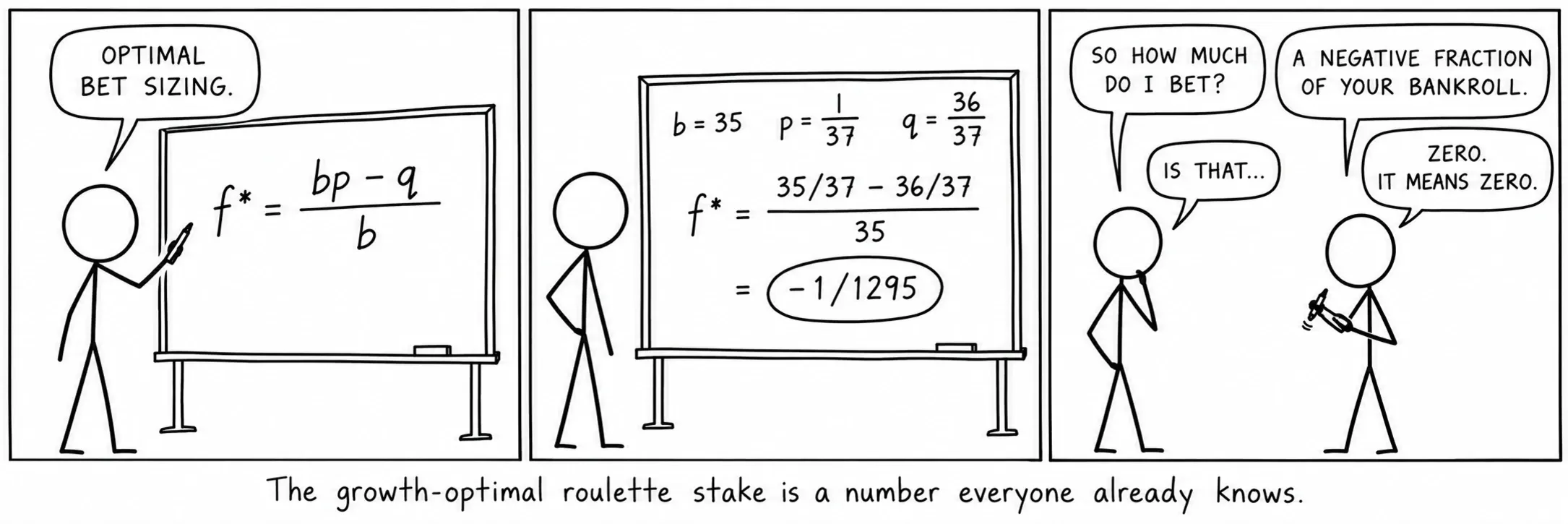
Ulog u ruletu koji optimizira rast broj je koji svi već znaju.
Izvori
- Kelly, J. L. “A new interpretation of information rate.”
- Breiman, L. “Optimal gambling systems for favorable games.”
- Thorp, E. O. “Optimal gambling systems for favorable games.”
- Thorp, E. O. The Mathematics of Gambling.
- Epstein, R. A. The Theory of Gambling and Statistical Logic, 2nd ed.
- Taylor, D. G. Games, Gambling, and Probability: An Introduction to Mathematics, 2nd ed.
- Ethier, S. N. The Doctrine of Chances: Probabilistic Aspects of Gambling.
- Haghani, V. & Dewey, R. “Rational decision-making under uncertainty: observed betting patterns on a biased coin.”